
Humpback Whale | Atlantic Ocean Marine Life Guide
Humpback whale facts Atlantic Ocean searches often begin with one question: why are these whales so famous? Known for their haunting songs and spectacular breaching displays, humpback whales are among the most recognizable marine mammals in the world. They migrate thousands of miles through the Atlantic Ocean each year, connecting polar feeding grounds with tropical breeding waters.
These massive yet graceful animals play a vital ecological role. By feeding in nutrient-rich waters and migrating across ocean basins, they help circulate nutrients and support marine ecosystems. Their recovery from near extinction is also one of the ocean’s most powerful conservation stories.
These massive yet graceful animals play a vital ecological role. By feeding in nutrient-rich waters and migrating across ocean basins, they help circulate nutrients and support marine ecosystems. Their recovery from near extinction is also one of the ocean’s most powerful conservation stories.
Quick Facts About Humpback Whale
- Scientific name: Megaptera novaeangliae
- Average size: 40–52 feet
- Weight: 25–40 tons
- Lifespan: 45–90 years
- Diet: Krill and small schooling fish
- Habitat: Open ocean, coastal waters, migration corridors
- Conservation status: Least Concern (IUCN)
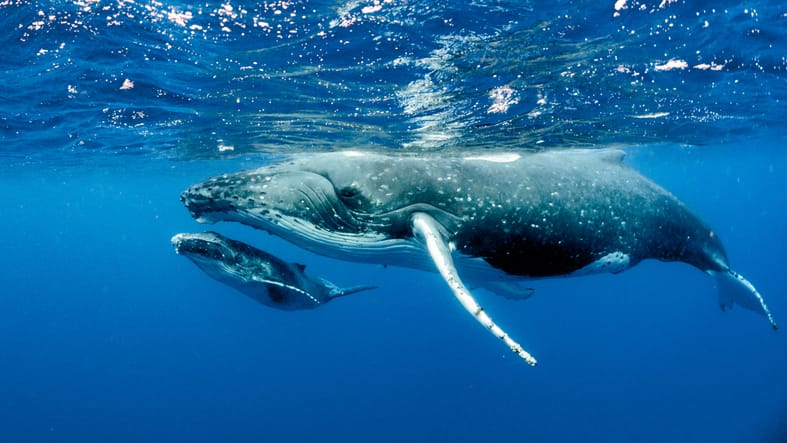
WHERE DOES THE HUMPBACK WHALE LIVE?
Humpback whales are found in every major ocean, including large portions of the Atlantic Ocean. They are highly migratory and move seasonally between cold feeding grounds and warmer breeding areas. Along the Atlantic, they travel predictable coastal routes.
Habitat & Range Breakdown
- Primary Atlantic regions: North Atlantic (from New England to Greenland), Caribbean breeding grounds, West Africa
- Coastal vs open ocean: Frequently seen in coastal waters during migration and feeding seasons; also travel offshore
- Typical depth range: Surface to several hundred feet while feeding
- Preferred water temperature: Cold, nutrient-rich waters for feeding; warm tropical waters for breeding
- Migration behavior (if applicable): Annual migrations of up to 5,000 miles between feeding and breeding grounds
WHAT DOES THE HUMPBACK WHALE EAT?
Humpback whales are baleen whales, meaning they filter small prey from the water rather than hunting large animals. They are carnivorous filter feeders and consume vast amounts of small marine life each day during feeding season.
By consuming and redistributing nutrients through waste and movement, humpbacks contribute to ocean productivity. Their feeding habits support the health of the marine food web.
Diet Breakdown
- Primary prey: Krill, herring, sand lance, mackerel, and other small schooling fish
- Hunting or feeding strategy: Bubble-net feeding, lunge feeding, cooperative group feeding
- Key adaptations: Baleen plates for filtering prey; expandable throat pleats that allow massive gulps of water
- Role in food chain: Mid-to-upper-level predator of small fish and crustaceans
By consuming and redistributing nutrients through waste and movement, humpbacks contribute to ocean productivity. Their feeding habits support the health of the marine food web.
BEHAVIOR AND UNIQUE CHARACTERISTICS
Humpback whales are known for complex behaviors rarely seen in other whale species. From long-distance songs to acrobatic leaps, they display remarkable intelligence and social interaction.
Trait Highlights
- Social Behavior: Often solitary or in small groups; cooperative feeding groups common
- Reproduction: Calves born in warm tropical waters after an 11–12 month gestation
- Speed or Mobility: Typically 3–9 mph; faster during migration
- Physical Adaptations: Extremely long pectoral fins (up to one-third of body length); knobby head called tubercles
- Unique Survival Traits: Complex songs that can last 20 minutes and travel miles underwater

WHERE TO SEE THE HUMPBACK WHALE IN THE ATLANTIC OCEAN
North America
North America offers some of the most reliable humpback whale sightings in the Atlantic Ocean. Seasonal feeding and migration patterns bring whales close to shore, especially in nutrient-rich northern waters.
Cape Cod, Massachusetts (USA)
- Best season: May–October
- Viewing experience: Boat-based whale watching tours
- Why sightings occur here: Stellwagen Bank provides abundant krill and fish
- Best season: June–August
- Viewing type: Coastal boat tours and shoreline observation
- Environmental factors: Cold currents and productive feeding grounds attract large numbers
CONSERVATION STATUS
Humpback whales are currently classified as Least Concern by the International Union for Conservation of Nature (IUCN). However, recovery varies by population, and continued monitoring is essential.
- Population trend: Increasing globally since the 1986 commercial whaling ban
- Primary threats: Ship strikes, entanglement in fishing gear, noise pollution
- Climate impact: Shifts in prey distribution due to warming oceans
- Fishing or human pressures: Coastal development and marine traffic
- Marine protections: International whaling ban; marine sanctuaries; vessel speed regulations
INTERESTING FACTS ABOUT THE HUMPBACK WHALE
- Humpback whales can consume up to 1.5 tons of food per day during feeding season.
- Each whale has a unique pattern on the underside of its tail, like a fingerprint.
- Their songs can travel for miles underwater.
- Calves may gain up to 100 pounds per day while nursing.
- They are among the most acrobatic large whales.
- Humpbacks were once hunted nearly to extinction in the Atlantic.
Frequently Asked Questions About the Humpback Whale
A humpback whale can grow up to 52 feet long, which is roughly the length of a standard city bus. They weigh as much as several adult elephants combined.
Breaching may help remove parasites, communicate with other whales, or simply express energy. Scientists continue to study the exact reasons.
Yes. Male humpbacks in the Atlantic Ocean are known for complex songs during breeding season. These songs can change gradually over time.
They are not considered dangerous. Encounters are typically peaceful, especially during regulated whale watching tours.
Some North Atlantic populations travel up to 5,000 miles annually between feeding and breeding areas.
Adult humpbacks have few natural predators, though orcas may target calves. Humans historically posed the greatest threat through commercial whaling.
Discover Life Beneath the Atlantic Ocean
From iconic marine species to the habitats that sustain them, explore the incredible life that makes the Atlantic Ocean one of the world’s most dynamic ecosystems.