
Great White Shark | Atlantic Ocean Marine Life Guide
The great white shark is one of the most powerful and fascinating predators in the Atlantic Ocean. Known for its size, intelligence, and role at the top of the food chain, this species has captured global attention for decades.
Beyond its reputation, the great white shark plays a vital ecological role in maintaining healthy marine ecosystems. From the coastal waters of North America to parts of Europe and Africa, this species helps regulate prey populations and balance ocean biodiversity.
Beyond its reputation, the great white shark plays a vital ecological role in maintaining healthy marine ecosystems. From the coastal waters of North America to parts of Europe and Africa, this species helps regulate prey populations and balance ocean biodiversity.
Quick Facts About Great White Shark
- Scientific name: Carcharodon carcharias
- Average size: 11–16 feet (3.4–4.9 meters)
- Weight: 1,500–2,400 pounds
- Lifespan: 30–70 years
- Diet: Marine mammals, fish, seabirds, and carrion
- Habitat: Coastal and offshore waters of the Atlantic Ocean
- Conservation status: Vulnerable (IUCN Red List)

WHERE DOES THE GREAT WHITE SHARK LIVE?
Great white sharks are widely distributed throughout the Atlantic Ocean. They prefer temperate and subtropical waters and are often found in productive coastal waters where prey is abundant.
Habitat & Range Breakdown
- Primary Atlantic regions: Eastern United States, Canada, Gulf of Mexico, Mediterranean Sea, South Africa
- Coastal vs open ocean: Primarily coastal waters but capable of long offshore migrations
- Typical depth range: Surface to 3,900 feet (most commonly near the surface)
- Preferred water temperature: 54–75°F (12–24°C)
- Migration behavior: Seasonal migrations following seal and fish populations
WHAT DOES THE GREAT WHITE SHARK EAT?
The great white shark is a carnivorous apex predator. Its diet changes as it grows, shifting from fish-based meals to larger marine mammals.
Diet Breakdown
- Primary prey: Seals, sea lions, large fish (such as tuna), dolphins, and occasionally sea turtles
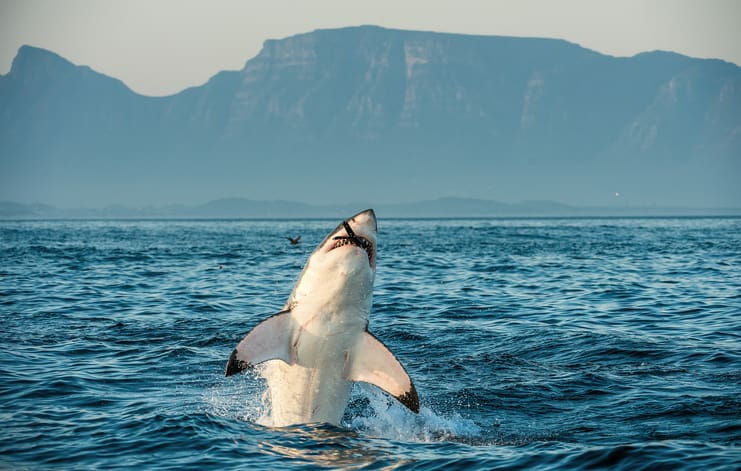
- Hunting or feeding strategy: Ambush predator; often attacks from below with powerful upward bursts
- Key adaptations: Serrated triangular teeth, strong bite force, acute sense of smell
- Role in food chain: Apex predator regulating marine mammal and fish populations
BEHAVIOR AND UNIQUE CHARACTERISTICS
Great white sharks are often solitary but demonstrate complex behaviors. They are highly intelligent and capable of long-distance navigation.
Trait Highlights
- Social Behavior: Primarily solitary; may gather at feeding sites
- Reproduction: Ovoviviparous (embryos develop inside eggs within the mother)
- Speed or Mobility: Can reach speeds up to 35 mph in short bursts
- Physical Adaptations: Countershading (dark top, white underside), electroreception via ampullae of Lorenzini
- Unique Survival Traits: Ability to detect a drop of blood in large volumes of water
WHERE TO SEE THE GREAT WHITE SHARK IN THE ATLANTIC OCEAN
Region: North America
North America offers some of the most reliable opportunities to observe great white sharks in the Atlantic Ocean. Seasonal migrations bring them close to shore where seal populations thrive.
Cape Cod, Massachusetts
- Best season: Late summer to early fall
- Viewing experience: Boat-based shark tours and research expeditions
- Why sightings occur here: Growing gray seal populations attract feeding sharks
- Best season: Summer
- Viewing type: Offshore tracking and tagging expeditions
- Environmental factors: Cold, nutrient-rich waters support prey species
CONSERVATION STATUS
The great white shark is currently listed as Vulnerable on the IUCN Red List. Although not immediately endangered, global populations face ongoing pressures.
- Population trend: Decreasing in some regions, stable or recovering in others
- Primary threats: Bycatch, illegal fishing, finning
- Climate impact: Shifting prey distributions may alter migration routes
- Fishing or human pressures: Accidental capture in commercial fisheries
- Marine protections: Protected status in several countries, including the United States
INTERESTING FACTS ABOUT THE GREAT WHITE SHARK
- Great whites can detect electrical signals produced by prey using specialized sensory organs.
- They can breach completely out of the water when attacking seals.
- Females are typically larger than males.
- Their teeth are continuously replaced throughout their lifetime.
- Satellite tagging has revealed transoceanic migrations across entire ocean basins.
- Despite their reputation, attacks on humans are extremely rare.
Frequently Asked Questions About the Great White Shark
Most adults measure between 11 and 16 feet, but some individuals have exceeded 20 feet. Females tend to grow larger than males.
Shark attacks are rare, and great whites do not actively hunt humans. Most incidents are believed to be cases of mistaken identity.
Research suggests they can live 30 to 70 years. Growth studies indicate they mature later than previously believed.
Yes, they undertake long seasonal migrations. Movements often follow seal populations and changing water temperatures in the Atlantic Ocean.
Adult great whites have few natural predators, but orcas have been documented preying on them in some regions.
As apex predators, they maintain balance in marine ecosystems by controlling prey species and preventing overpopulation.
Discover Life Beneath the Atlantic Ocean
From iconic marine species to the habitats that sustain them, explore the incredible life that makes the Atlantic Ocean one of the world’s most dynamic ecosystems.